

Why Healthcare Organizations Must Rethink Governance, Operational Alignment, and Decision-Making Before Complexity Overwhelms Performance
Healthcare organizations are operating under extraordinary pressure.
Margins remain unstable. Labor shortages continue affecting operations across the country. Clinician burnout remains high. Supply disruptions have not fully stabilized. Capital constraints are tightening. Reimbursement uncertainty continues creating financial strain. At the same time, executive leaders are being asked to improve operational performance while reducing cost and complexity.
Yet despite all of this pressure, many healthcare organizations continue operating within highly fragmented supply environments that quietly create inefficiency across nearly every aspect of the enterprise.
And in many cases, the true impact is not fully visible. Supplier fragmentation is often viewed as simply “having too many vendors.” But the reality is far more complex than that.
Fragmentation creates disconnected decision-making.
- It weakens governance.
- It increases operational variation.
- It slows implementation.
- It creates contract leakage.
- It complicates analytics.
- It frustrates clinicians.
And over time, it quietly erodes organizational discipline across the health system.
Many healthcare organizations do not intentionally design fragmented environments. They evolve into them gradually through years of decentralized decision-making, siloed departments, physician preference variation, acquisitions, inconsistent governance structures, urgent operational demands, and reactive problem-solving.
Eventually, organizations find themselves operating in environments where standardization becomes increasingly difficult, accountability becomes unclear, implementation slows down, and operational complexity starts compounding faster than the organization can effectively manage it.
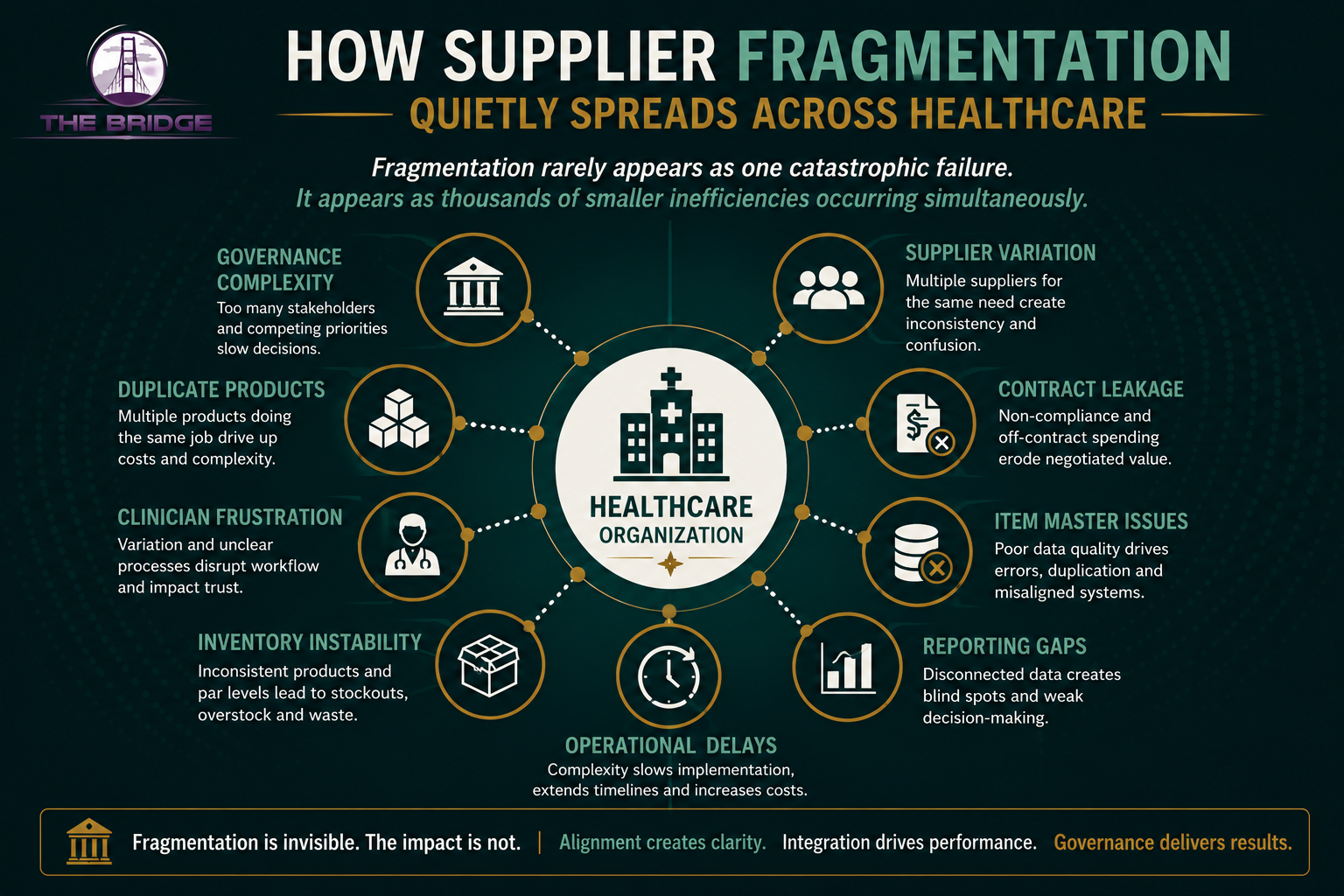
The challenge is that fragmentation rarely appears as one catastrophic operational failure. Instead, it appears as thousands of smaller inefficiencies occurring simultaneously across the organization every single day.
It appears in:
- duplicate products across departments
- unmanaged clinical variation
- inventory inconsistency between sites
- disconnected item masters
- contract non-compliance
- fragmented reporting structures
- unclear ownership of operational decisions
- prolonged value analysis cycles
- implementation failures
- competing stakeholder priorities
- inconsistent operational accountability
- and difficulty translating decisions into measurable outcomes
Individually, many of these issues may appear manageable. Collectively, they create enormous organizational drag. And that drag becomes increasingly dangerous during periods of financial instability and operational pressure.
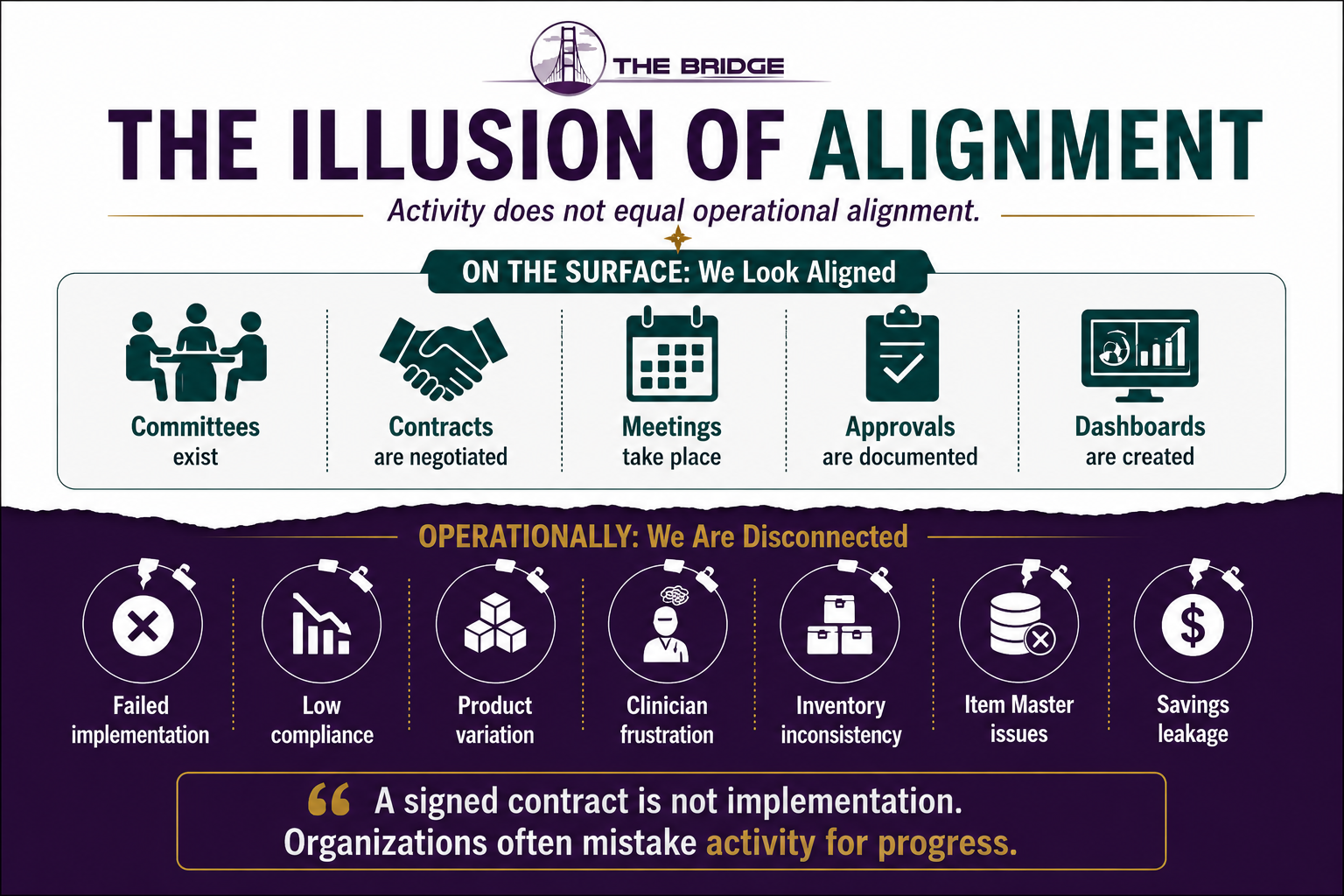
One of the biggest challenges healthcare organizations face today is what I often describe as “the illusion of alignment.”
On the surface, many organizations appear aligned.
- Committees exist.
- Meetings occur regularly.
- Contracts are negotiated.
- Initiatives are approved.
- Governance structures are documented.
- Stakeholders participate in discussions.
But operationally, many organizations remain deeply disconnected.
- Products approved through value analysis are never fully implemented.
- Contracted products fail to achieve compliance targets.
- Departments continue purchasing outside standardization efforts.
- Analytics do not align with operational reality.
- Clinicians receive mixed messaging.
- Operational ownership becomes fragmented across multiple teams.
- And accountability often disappears after the meeting ends.
This creates one of the most expensive problems in healthcare operations: Organizations mistake activity for progress.
- A committee meeting is not transformation.
- A signed contract is not implementation.
- A sourcing decision is not operational adoption.
- And reported savings are not always realized outcomes.
This is where many healthcare organizations quietly struggle. Not because people do not care. Not because teams are not working hard. But because operational complexity has outgrown the organization’s governance maturity.
This is especially visible within value analysis and clinically integrated supply chain environments. Many organizations still operate with disconnected workflows between supply chain, clinical operations, finance, analytics, procurement, and executive leadership.
- One department may approve a product.
- Another negotiates the contract.
- Another manages implementation.
- Another oversees inventory.
- Another tracks analytics.
- Another communicates with clinicians.
Yet no one fully owns the end-to-end operational outcome. This creates what I call “decision disconnect,” where decisions are technically made but operationally never fully realized. And that disconnect becomes extremely expensive over time.
Healthcare organizations often underestimate how exhausting fragmentation becomes for clinicians as well. Clinicians are already operating under immense pressure. When operational environments become overly fragmented, clinicians are forced to navigate:
- inconsistent products
- changing workflows
- duplicate systems
- unclear communication
- supply variability
- inconsistent implementation
- and operational confusion between departments
Over time, this weakens trust. Not only trust in supply chain initiatives, but trust in the organization’s ability to execute operationally. That is why modern healthcare supply chain leadership can no longer focus solely on contracting and cost reduction. The future of healthcare supply chain is becoming increasingly centered around operational integration, governance, implementation discipline, and enterprise alignment.
Healthcare organizations are now entering an era where operational discipline will matter more than ever.
- Financial pressure continues increasing.
- Geopolitical disruption continues affecting supply continuity.
- Cybersecurity concerns are growing.
- Workforce shortages remain significant.
And executive leadership teams are demanding measurable operational performance, not theoretical strategy.
Organizations simply cannot afford uncontrolled operational complexity anymore. The organizations making meaningful progress are beginning to recognize that supplier fragmentation is no longer just a supply chain issue. It is an enterprise operational issue. This distinction matters. Because fragmentation impacts far more than pricing.
It impacts:
- operational consistency
- clinician experience
- patient throughput
- implementation speed
- reporting accuracy
- inventory efficiency
- financial visibility
- organizational trust
- and executive decision-making
The organizations beginning to stabilize operational complexity are focusing heavily on:
- enterprise visibility
- clinically integrated governance
- supplier rationalization
- implementation accountability
- lifecycle management
- operational ownership
- standardized decision-making
- and stronger data integrity
Most importantly, they are recognizing that governance is no longer optional. But governance must evolve. Not governance designed to slow decisions. Governance designed to create clarity. That means clearer ownership.
- Clearer operational accountability.
- Clearer implementation expectations.
- Clearer alignment between clinical, operational, and financial stakeholders.
And stronger visibility into whether decisions are actually producing measurable outcomes.
This also requires healthcare organizations to move beyond transactional thinking. Because healthcare supply chain is no longer functioning as a transactional department. It has become a strategic control point that directly influences:
- financial stability
- operational continuity
- clinician alignment
- patient care delivery
- enterprise resiliency
- and organizational performance
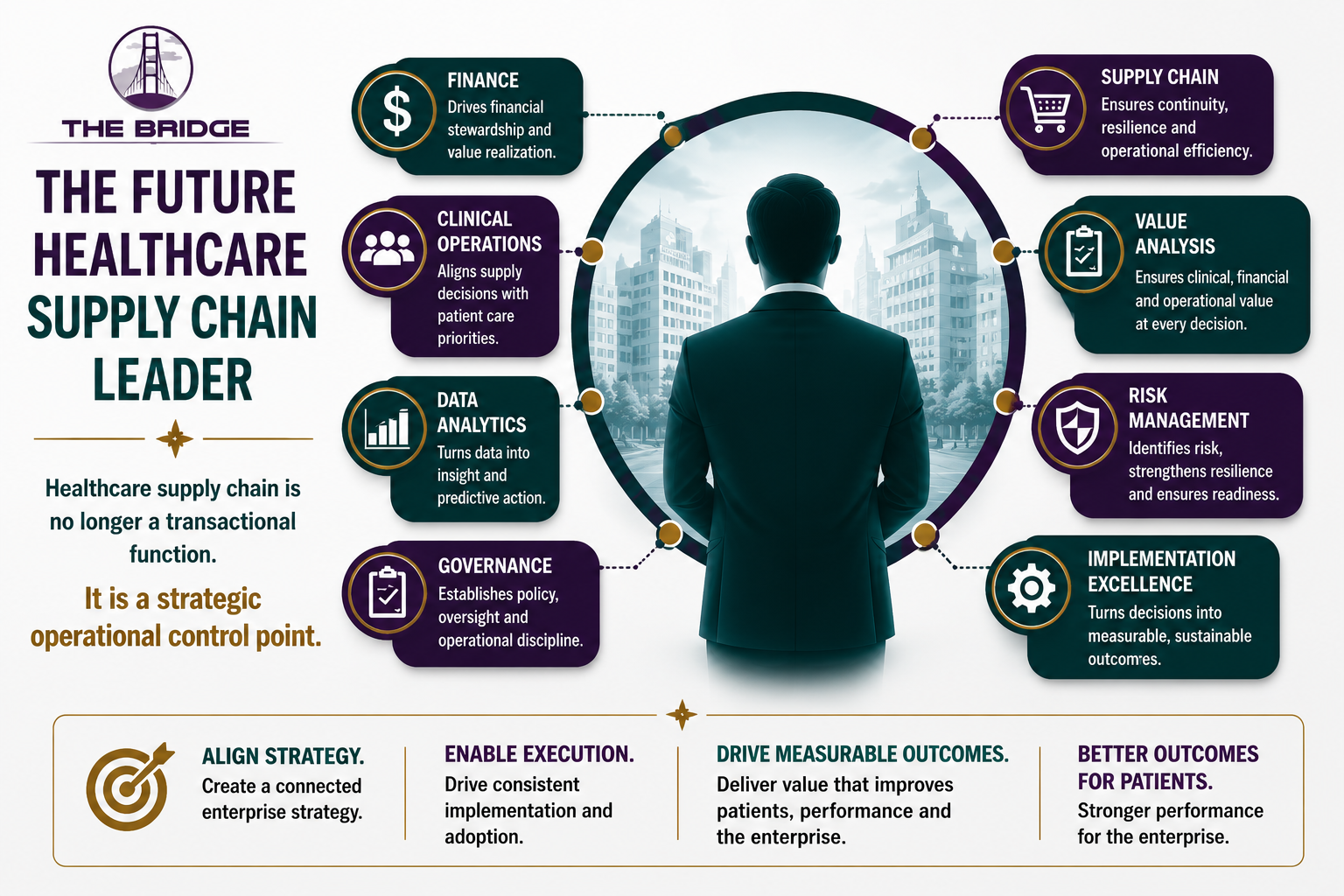
The future healthcare organization will require significantly more integration between supply chain, value analysis, clinical operations, finance, informatics, and executive leadership than many systems currently have today.
And organizations that fail to evolve operationally may continue experiencing the same invisible friction that quietly slows transformation efforts year after year. This does not mean healthcare organizations need perfect standardization. Healthcare is far too complex for simplistic operational models.
But organizations do need:
- stronger alignment
- clearer governance
- improved operational accountability
- better implementation discipline
- and a more connected enterprise strategy
Because complexity across healthcare is growing rapidly. The question is whether organizational capability is evolving fast enough to manage it.
The organizations that recognize this shift early will be significantly better positioned for the future. The organizations that do not may continue struggling with operational fragmentation that quietly weakens execution, slows transformation, increases financial pressure, and limits their ability to adapt in an increasingly complex healthcare environment.
And in today’s healthcare landscape, operational complexity is no longer just an operational inconvenience. It is becoming a strategic risk.
Article by:
Angelique Beslic, Sr. Director of Supply Chain, Legacy Health; Executive Consultant and Principal of Bridge Ventures, LLC
Angelique Beslic is a healthcare supply chain executive, educator, and industry thought leader focused on clinically integrated supply chain transformation, governance, value analysis, strategic sourcing, and operational alignment. She is the founder of The Bridge Venturers LLC – The Healthcare Supply Chain Hub and developer of multiple ISCEA-accredited healthcare supply chain certification programs designed to advance modern healthcare supply chain leadership capabilities.
Articles you may like:


