

The Challenge of Recall Communication
Medical device recalls are intended to protect patients, yet one of the greatest delays can occur after a notice is issued, when healthcare teams are working to understand scope, translate requirements into workflow, and move quickly to mitigation. Across healthcare systems, recall teams manage hundreds of events each year, from packaging corrections to urgent Class I actions involving products that could cause serious injury or death. Every recall begins with communication, and the clearer that communication is, the faster providers can respond.
The challenge is rarely intent or effort, it is variability. Recall communications must document what happened, meet regulatory expectations, and support immediate action across a wide range of customers and care settings. Notices may arrive as letters, PDFs, spreadsheets, web links, or portal messages, each with different terminology and layout. When key operational details are difficult to locate, recall teams spend valuable time confirming scope and next steps instead of reducing risk.
A recall notice is most effective when it can be used immediately, pairing clinical context with clearly labeled, structured fields that support rapid execution.
Many notices include important background and patient safety context but recall teams must also quickly capture details in a recall system, route actions to Supply Chain, HTM, Pharmacy, and clinical areas, and document completion for audit readiness. When operational details are buried in narrative sections, or separated across attachments and follow-up emails, providers lose time.
The goal is simple: the same notice that satisfies notification requirements should also support the real work providers must do – identify impacted product, confirm patient exposure when applicable, carry out disposition, and document closure.
Sortable data, such as an Excel attachment, is often the fastest way for recall teams to filter, match, and validate product and lot lists. Letters and PDFs may support formal documentation, but structured lists help teams move immediately to inventory identification and outreach. Even formatting matters. Consistent fonts, clear headers, and unambiguous characters reduce transcription errors when information is being copied into enterprise systems.
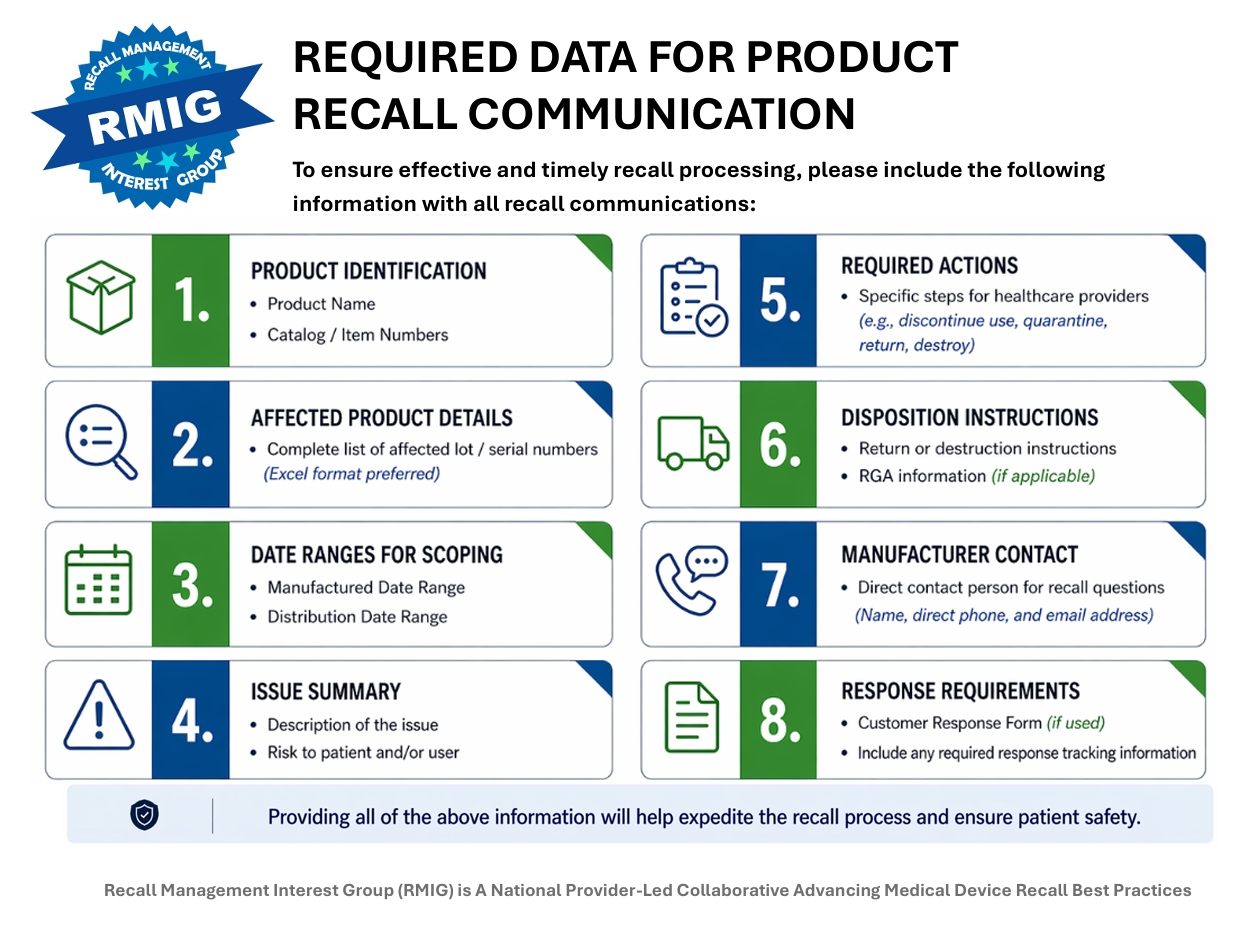
Product identification is a frequent friction point because provider inventory systems depend on precise identifiers. Broad ranges such as “1234XXX through 9999XXX” are difficult to translate into catalog and item records. Clear catalog numbers, item numbers, UDI details when available, complete lot or serial lists, and manufacturing and distribution date ranges are critical.
Date ranges define scope. Without them, providers often default to running broad purchase history searches going back months or years just to avoid missing affected product, only to later find the true affected window was a few days. That creates unnecessary work, delays response, and pulls focus from higher-risk recalls.
If a response is required, the response form should be included in the initial notice. If the notice requires a response but the form is missing, providers cannot complete the recall without additional follow-up, creating avoidable delays.
Disposition instructions must also be specific. Phrases like “please inspect inventory” can be interpreted differently across sites. Clear direction – quarantine, relabel, return, destroy, or correct onsite – helps end users act consistently and supports audit-ready documentation.
Standardization is about creating clear communication that helps providers act quickly, consistently, and safely across complex healthcare environments.
A Provider-Built Solution
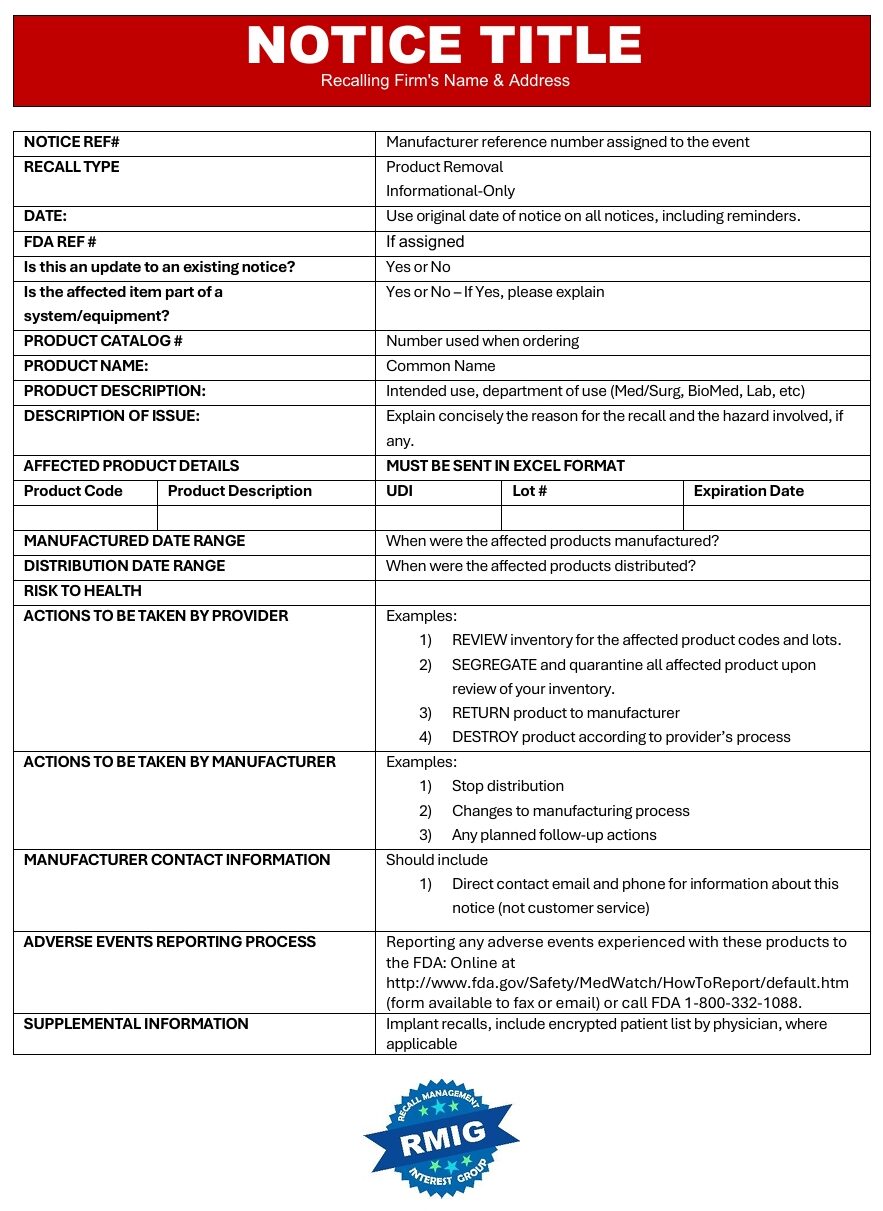
In response to these challenges, the Recall Management Interest Group (RMIG), a national, provider-led collaborative focused on improving medical device recall management, developed a standardized Recall Notice Template.
The template outlines the minimum information needed to move a recall from awareness to action. It is intended to complement existing manufacturer processes and regulatory obligations, not replace them. By presenting key data in a consistent layout, the template reduces avoidable follow-up, shortens time-to-clarity, and helps ensure the same message can be understood by the many roles involved in recall execution.
It emphasizes clear product identification, complete lot and model information, manufacturing and distribution date ranges, a concise issue summary, explicit actions, disposition instructions, included response forms, direct contact information, and clear response requirements.
If an FDA classification or Z-number has been assigned, including it helps providers align urgency and documentation. If classification is pending, stating that clearly is equally helpful so teams understand additional details may follow.
Manufacturing and distribution date ranges are equally important. Clear parameters help providers determine whether inventory on hand, or products already used on patients, fall within scope. This reduces unnecessary quarantines while protecting against missed impacted product.
When a recall is updated, clear traceability to the original event helps providers connect the record from initiation to closure. Maintaining a consistent reference number, or clearly cross-referencing previous and new numbers, reduces confusion, duplicate work, and missed action.
Why Standardization Matters
Consistency creates repeatable workflows, improves communication between manufacturers and providers, reduces administrative burden, strengthens audit readiness, and most importantly, enables faster risk mitigation for patients. In a high-stakes environment, standardization is a safety tool.
This work is not about convenience; it is about patient safety.
Alert fatigue is real. As recalls are updated, expanded, or reissued, providers must quickly determine what is new and what action is required. If updates are unclear, end users may assume they have already seen the notice and stop paying attention.
Clear, well-labeled updates help prevent missed action. Standard conventions, such as an Update Summary section and consistent placement of revised lot lists or deadlines, make a meaningful difference during busy clinical operations.
Healthcare systems continue improving internal recall workflows, but no internal process can fully compensate for inefficient communication at the point of notification. Better communication creates a shared win for manufacturers, providers, regulators, and most importantly, patients.
Moving from Notification to Safety
Even the strongest recall program depends on usable information. When basic details are clear up front, providers can spend less time clarifying and more time locating product, notifying end users, coordinating returns, correcting labeling, and documenting completion.
A recall notice is not successful simply because it was sent.
It is successful when the right people understand exactly what to do and can do it quickly.
That is the difference between notification and safety.
Manufacturers, providers, regulators, and industry partners all share the same goal: protecting patients and preventing harm. Standardized recall communication is one of the simplest and most effective ways to support that goal because it turns information into action with fewer delays.
A recall notice should mark the beginning of action, not the beginning of investigation.
That is how we move, together, from notification to safety.
Author Note
The views expressed in this article are the author’s own and do not necessarily reflect the views or policies of Mayo Clinic.
Article by:
Amy Conway, M.S.Ed., Enterprise Recall Analyst, Mayo Clinic; Co-Founder, Recall Management Interest Group (RMIG)
Amy is the Enterprise Recall Analyst for Mayo Clinic Supply Chain Management, with 10 years in the organization and more than 30 years of experience in manufacturing and supply chain operations, and a founding member of the Recall Management Interest Group (RMIG).
Articles you may like:
UDI in Theory vs. UDI in Practice: Why Recalls Still Rely on Manual Workflows